

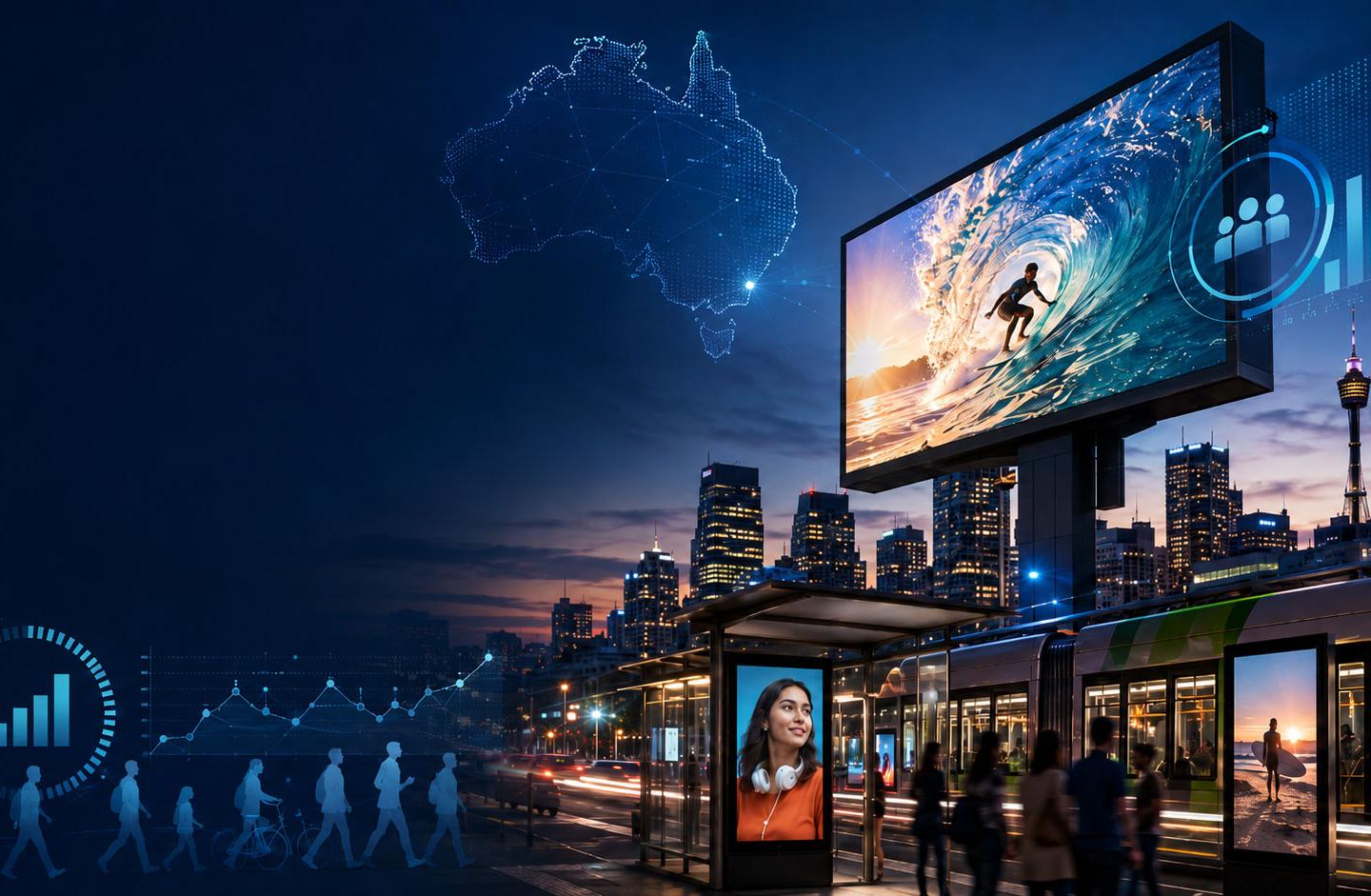
Australia’s MOVE Moment: How a New OOH Currency Is Rewriting the Rules of Outdoor Advertising
A human, boardroom-ready industry article on why Australia’s unified OOH measurement system is more than a technical upgrade. It is a confidence machine for the medium.
OUT OF HOME ADVERTISING | AUSTRALIA | MOVE
Australia’s MOVE Moment: The New Currency Rewriting Out-of-Home Advertising
A human, boardroom-ready industry article on why Australia’s unified OOH measurement system is more than a technical upgrade. It is a confidence machine for the medium.
The industry did not just get a new tool
Out-of-home advertising has always had a peculiar power. It sits in the real world, where people walk, wait, commute, shop, linger, and live. For decades, that physical certainty gave the medium its charm, but also its handicap. Everyone could see the billboard. Not everyone could agree, with modern precision, who saw it, how often they saw it, what journey they were on, and how that exposure should be valued alongside other media.
That is why Australia’s launch of MOVE matters. On the surface, it is a new audience measurement system for out-of-home. Beneath the surface, it is a change in the commercial grammar of the category. From 16 March 2026, MOVE became the united currency and sole industry standard for planning, buying and reporting OOH campaigns in Australia. That sentence may sound administrative, but in media terms it is tectonic. Currencies decide how confidence is created, how budgets are defended, and how a medium earns its place in the strategy room.
The old argument for outdoor was often built on scale, fame and presence. Those virtues still matter. A city does not become less persuasive because a dashboard arrives. But the buying market has changed. Marketers now live under the fluorescent stare of accountability. Procurement asks sharper questions. CFOs want proof, not poetry. Agencies need consistent data that can survive the friction of planning, optimisation and post-campaign review. MOVE is Australia’s attempt to give OOH the measurement spine it needs for this era.
From exposure to evidence
MOVE stands for Measurement of Outdoor Visibility and Exposure, and the ambition is clear: make OOH measurement more detailed, more unified and more useful across formats and environments. The official industry launch opened MOVE data to OMA media owner members and licensed agencies from 9 March 2026, with the full transition following a week later. The important point is not merely the date. It is the fact that Australia has chosen a single, shared framework for the industry instead of letting the market fragment into a fog of competing claims.
That shared currency is the quiet miracle here. In any mature media ecosystem, the measurement system is not just a spreadsheet with better shoes. It is a trust contract. Buyers and sellers may still negotiate fiercely, but they begin with the same language. That reduces the amount of energy wasted arguing over whose numbers are real and increases the energy spent on better planning, stronger creative and more intelligent deployment of media assets.
The leap with MOVE is that it does not treat outdoor simply as a static reach machine. Reports around the launch point to richer mobility and behavioural inputs, synthetic audiences, viewability logic, hourly and seasonal nuance, and broader national coverage. In human terms, that means planners can move beyond asking, ‘How many people could pass this site?’ and start asking, ‘Which people are likely to be in this environment, when, in what mindset, and with what opportunity to notice?’ That is a very different kind of conversation.
Regional Australia steps into the measurement light
One of the more important industry signals is the attention given to regional Australia and place-based environments. For too long, regional OOH has often carried the burden of under-measurement. That does not mean the audiences were not valuable. It means the industry lacked the kind of common evidence needed to bring those audiences into plans with the same confidence as major metropolitan sites.
MOVE changes that dynamic by helping close long-standing gaps in regional and place-based measurement. This matters because Australia is not just Sydney, Melbourne and a handful of premium roadside corridors. It is shopping centres, airports, transit networks, regional towns, local roads, health precincts, education environments, entertainment districts and neighbourhood routines. If a measurement currency cannot see that complexity, the investment conversation becomes narrower than the country itself.
For advertisers, this is a practical unlock. Better regional data can help national brands build broader reach with greater confidence. It can help local and state campaigns justify investment in communities that were previously harder to quantify. It can also give media owners outside the most obvious metro corridors a stronger seat at the table. In a market where every channel fights to prove incremental value, better visibility can turn previously overlooked inventory into strategically defensible media.
The global benchmark question
The Invidis framing of MOVE as a potential global benchmark is not casual praise. OOH measurement is a worldwide puzzle. The medium is public, physical, fragmented by format, influenced by traffic patterns, sensitive to environment, and increasingly digital. Unlike online advertising, OOH cannot simply count a server event and call it exposure. It must model real human movement and genuine opportunity to see. That makes the task harder, but also more meaningful when done well.
Australia’s advantage appears to be collaboration. The industry did not merely bolt a shiny dashboard onto a legacy system and declare victory. The launch coverage repeatedly points to broad support across media owners, agencies and industry bodies. That collaboration is not glamorous, but it is the difference between a tool and a currency. A tool can be ignored. A currency becomes the market’s shared operating system.
For other markets watching from the sidelines, the lesson is not that they should copy Australia line by line. Media infrastructure is local. Commuting patterns, geography, privacy regulation, data access and market structure vary. The lesson is that OOH needs common standards strong enough to serve modern buying without stripping the medium of its physical intelligence. MOVE’s global relevance will depend on how effectively it translates complexity into confidence.
What this means for brands and agencies
For brands, MOVE should make OOH easier to defend in mixed-media plans. The channel has never lacked emotional and cultural force. A strong outdoor campaign still has the public theatre that private screens cannot replicate. What has often been missing is a measurement layer that lets marketers connect that theatre to the sober rituals of planning, comparison and reporting.
For agencies, the change is equally significant. Planning teams can now approach OOH with a more granular understanding of audience behaviour across time and location. Investment teams get a more consistent basis for evaluating proposals. Strategy teams can think harder about context, not just coverage. Creative teams, if they are wise, should treat this as permission to design for moments, not merely surfaces. A roadside panel at 8:15 am is not the same human context as a retail screen at 6:40 pm. Better measurement should lead to better creative choices, not just prettier post-campaign reports.
There is also a deeper implication for programmatic digital out-of-home. As DOOH grows, the market will need better data to decide when automation adds value and when it merely adds machinery. Programmatic OOH is only as good as the signals beneath it. MOVE gives the Australian market a stronger base for smarter trading, sharper targeting and more credible accountability.
The caution: measurement is not magic
The industry should resist the temptation to turn MOVE into a silver statue. Measurement systems are powerful, but they are not magic. They improve decision-making; they do not replace judgement. A great currency can still be used to buy poor media, weak creative or lazy strategy. The danger with any new measurement infrastructure is that the market becomes intoxicated by precision and forgets persuasion.
Outdoor advertising works because it meets people in the open world. It earns attention through scale, placement, repetition, context and creative clarity. MOVE can help the industry understand these variables with more rigour, but it cannot rescue a dull message. The best operators will use the new currency not as a cage, but as a compass. It should guide smarter choices without flattening the craft of the medium.
A confidence machine for the next chapter of OOH
Australia’s MOVE launch arrives at a useful moment. The OOH sector has been growing, digital formats are expanding, and advertisers are demanding sharper proof from every channel. Against that backdrop, MOVE gives the industry something it badly needs: a stronger common foundation for trust.
The real achievement is not simply that Australia has built a more advanced measurement model. It is that the market has aligned around it. That alignment can shorten arguments, strengthen budgets, elevate regional inventory, improve planning discipline and make OOH more fluent in the language of modern marketing. For a medium rooted in the streets, MOVE gives outdoor a passport into the most demanding rooms of media investment.
The future of OOH will not be won by measurement alone. It will be won by the brands, agencies and media owners who combine measurement with imagination. MOVE supplies the evidence. The industry still has to supply the nerve.
Key industry takeaway
|
Reference pieces reviewed
- Outdoor Media Association: “MOVE LIVE for the Out of Home Industry”, 9 March 2026.
- Mediaweek: “Out of home levels up: MOVE audience measurement is live”, 9 March 2026.
- AdNews: “Australia’s new OOH measurement currency goes live”, 9 March 2026.
- Invidis: “New OOH Currency: Australia Launches MOVE as a Global Benchmark”, March 2026.
- MOVE official site: “Measurement of Outdoor Visibility and Exposure”.
- oOh!media: “MOVE Go Live Announced for March”, January 2026.
- Mi3: MOVE global perspective and launch-related coverage, 2026.